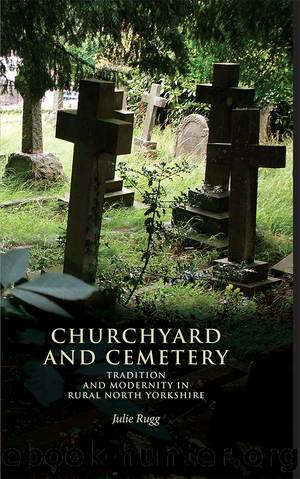
Churchyard and cemetery by Julie Rugg
Author:Julie Rugg [Rugg, Julie]
Language: eng
Format: epub
Tags: Social Science, Death & Dying, History, Europe, Great Britain, General, Social History
ISBN: 9781526103536
Google: Jm65DwAAQBAJ
Publisher: Manchester University Press
Published: 2015-11-01T00:37:29+00:00
Conclusion
This chapter has considered the religious politics of burial in central North Riding, with the aim of arriving at an understanding of how far the Church of England lost control of burial space in the area during the second half of the nineteenth century. Methodism was by far the dominant Nonconformist denomination, although pockets of the Old Dissent were evident in the market towns. The operation of the Burial Acts indicated that there were evident tensions in meeting requirements as to consecration and apportionment. In some burial board cemeteries in the study, substantial use was made of unconsecrated sections, which indicated some level of dissatisfaction with the notion of burial with an Anglican minister in consecrated ground. However, in only one instance was it the case that burials in unconsecrated ground approached being a majority option, despite the strength of Dissent generally in this part of Yorkshire. The Burial Acts had meant that the Church of England had indeed extended its provision of consecrated space without recourse to the church rate. Furthermore, it remained the case that the Anglican minister would take payment for all burials in the consecrated sections â irrespective of whether he had indeed taken the service. With the advent of the Burial Laws Amendment Act, it became possible for Nonconformist ministers to hold funeral services in the churchyard. Evidence from 25 churchyards shows that take-up of this option tended to be low in more rural locations, possibly reflecting the practicalities of securing the service of an itinerant Methodist ministry. It may also be the case that a willingness to continue using the vicar reflected a more intrinsic regard for tradition, particularly at a time of extreme emotional vulnerability.
By the end of the nineteenth century, the Burial Acts had not heralded any disconnect in the religious traditions of English burial culture. Although the Church of England no longer had a secure monopoly of burial provision, in actuality its holding of consecrated space increased substantially. From 1850 to 1894, 25 new churches were built in central North Riding, each providing a new churchyard; furthermore â as Chapter 4 demonstrated â numerous churchyards were extended. In addition, in each of the burial board cemeteries, at least half â and often more â of the ground was consecrated. In these spaces, it remained the case that burial fees were payable to the Anglican parish vicar whoever the officiating minister had been. Although Orders in Council were created to close churchyards in the area, these closures generally signalled either the addition of an extension to the site or a new, partly consecrated, cemetery. Nevertheless, the supply of non-Anglican burial space did also increase substantially. In the market towns particularly, there was enthusiastic use of unconsecrated sections of the burial board sites. However, it is perhaps important to reflect that, during the second half of the nineteenth century, any shift away from Anglican burial provision did not reflect a secularising tendency. On the contrary, Nonconformists desire for unconsecrated burial space demonstrated a strength of spiritual resolve and the desire to express religious commitment.
Download
This site does not store any files on its server. We only index and link to content provided by other sites. Please contact the content providers to delete copyright contents if any and email us, we'll remove relevant links or contents immediately.
The Vikings: Conquering England, France, and Ireland by Wernick Robert(84374)
Ali Pasha, Lion of Ioannina by Eugenia Russell & Eugenia Russell(40315)
The Conquerors (The Winning of America Series Book 3) by Eckert Allan W(37892)
The Vikings: Discoverers of a New World by Wernick Robert(37006)
Cecilia; Or, Memoirs of an Heiress — Volume 1 by Fanny Burney(32635)
Cecilia; Or, Memoirs of an Heiress — Volume 2 by Fanny Burney(32010)
Cecilia; Or, Memoirs of an Heiress — Volume 3 by Fanny Burney(31996)
Empire of the Sikhs by Patwant Singh(23135)
The Secret History by Donna Tartt(19291)
Hans Sturm: A Soldier's Odyssey on the Eastern Front by Gordon Williamson(18648)
Cat's cradle by Kurt Vonnegut(15441)
Pimp by Iceberg Slim(14661)
Sapiens: A Brief History of Humankind by Yuval Noah Harari(14458)
Norse Mythology by Gaiman Neil(13457)
Talking to Strangers by Malcolm Gladwell(13438)
Leonardo da Vinci by Walter Isaacson(13407)
4 3 2 1: A Novel by Paul Auster(12505)
Underground: A Human History of the Worlds Beneath Our Feet by Will Hunt(12144)
The Radium Girls by Kate Moore(12089)
